This week I visited BETT 2026. I always enjoy going to BETT and had quite a flying visit this time due to other commitments. My day began with a talk in The Arena by Lego Education titled “From mystery to mastery: Building AI Literacy Through Creativity and Collaboration”. This talk was both interesting and engaging, discussing how a class of children came up with ideas for AI policy and how it should work. You can view a video and full information on the Lego Education AI Page.
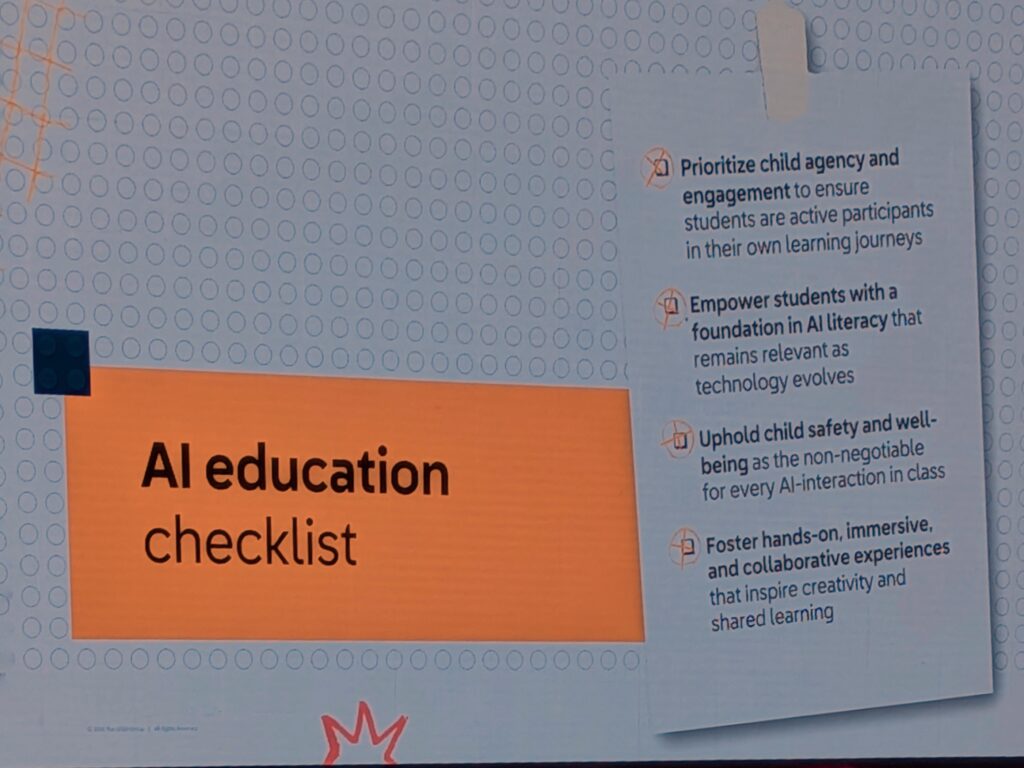
The presenter raised a valid point that stuck with me, that although AI can be made “safer” it can’t truly be made “safe“, so as an educator this is something to keep in mind. Another key message was to not anthropomorphise AI – when AI is given a face (or even worse, embedded into a toy) it can result in children getting more attached to the AI than they should and result in them confiding in AI rather than a trusted adult. This was an important point that was also raised in another AI course I took recently.
Within the talk, the guest speakers from an academy trust in London (I forgot to write down their names!) also discussed AI policies in schools and how it should not just be a stand-alone policy but should be embedded across all policies.
Just an aside, before this talk I caught the tail-end of the session from BBC Bitesize who highlighted a really good subset of their Bitesize site, called The Other Side of the Story providing resources around digital literacy and how to recognise real and fake information online. There’s even an online mini-series that you can watch and discuss in school.
My Favourite Tech at BETT
I always love checking out new tech in education so BETT is the place to be for this! If you’ve read this blog before, you’ll know I’m a huge fan of robotics so it was nice to see a range of robots on show as well as the underlying tech behind them.
Here’s a short overview of my day:
My first stop was the Ohbot stand, who have some nice new additions to their range, with robot heads that talk and can even have conversations with one another! Their software has been updated in recent years too and is intuitive and easy to use for children due to it being similar to Scratch and MakeCode. It even features built-in functions for lip-syncing and a range of expressions, with the LED Picoh version even being able to express a range of emotions! It’s certainly progressed a long way from the original Ohbot I purchased around 12 years ago!
My next stop was Redfern Electronics, home to the Crumble Controller; I always enjoy visiting the Redfern stand as they always use their tech in interesting and creative ways with a huge focus on fun, art and creativity! There’s a new Crumble board coming soon!
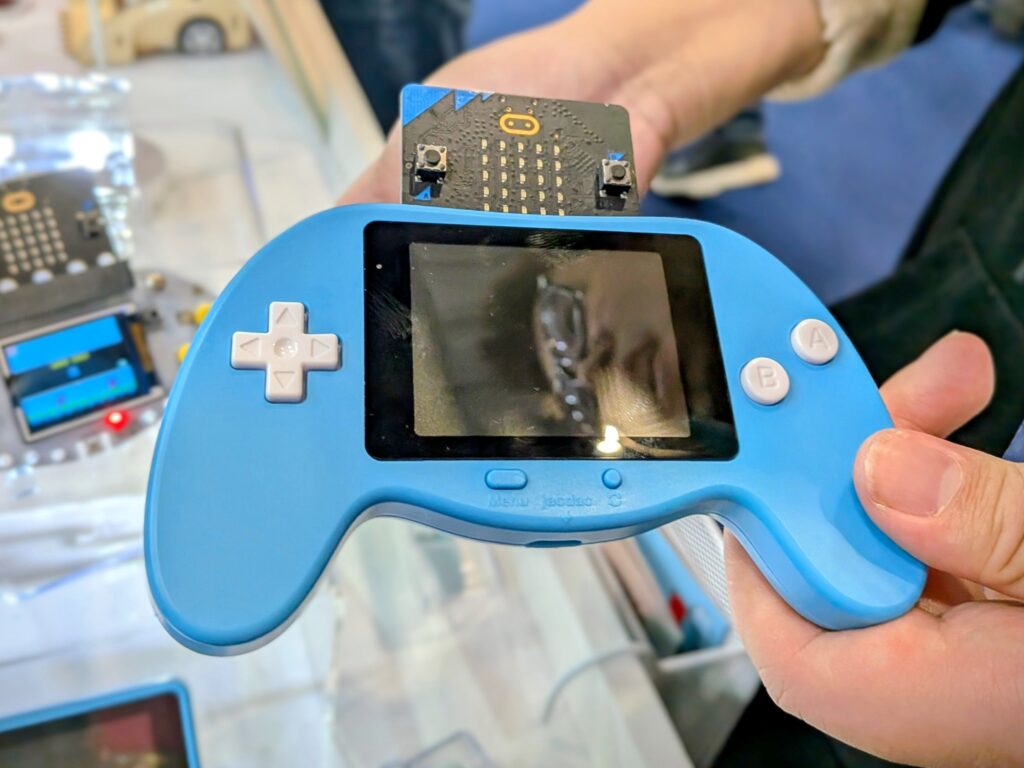
Elecfreaks, as usual, had a great range of tech for the classroom, all built around using the micro:bit. Their new addition being a bipedal robot that looks like it’s come straight out of a Star Wars movie that will be released in March and a new Arcade controller with a bigger screen, I very nearly purchased this before remembering I already own more hand-held controllers than I really need!
Make Stuff Move had some interesting breakout boards that work with micro:bit and Arduino and provide a range of different kits for the classroom, including servos in very sturdy surrounds that you can even drill-into to make new things.
Another highlight for me was the DF Robot stand, DF Robot have a huge range of electronic components for building projects with micro:bit, Raspberry Pi and Arduino, their Husky Lens AI camera being a recent favourite of mine, along with the K10 board which I purchased at BETT last year. This year they were showcasing their new Husky Lens 2.0, this features on-board machine learning that enables you to train the camera module to recognise various objects or animals as part of bigger projects, combined with the micro:bit. The Husky Lens 2.0 works in the same way as the previous module but has a faster processor and can recognise more objects, it also features interchangeable lenses to enable you to focus on different things depending on your needs. The example that particularly intrigued me was the microscopic lens being used to identify various cells.
AI Book Launch
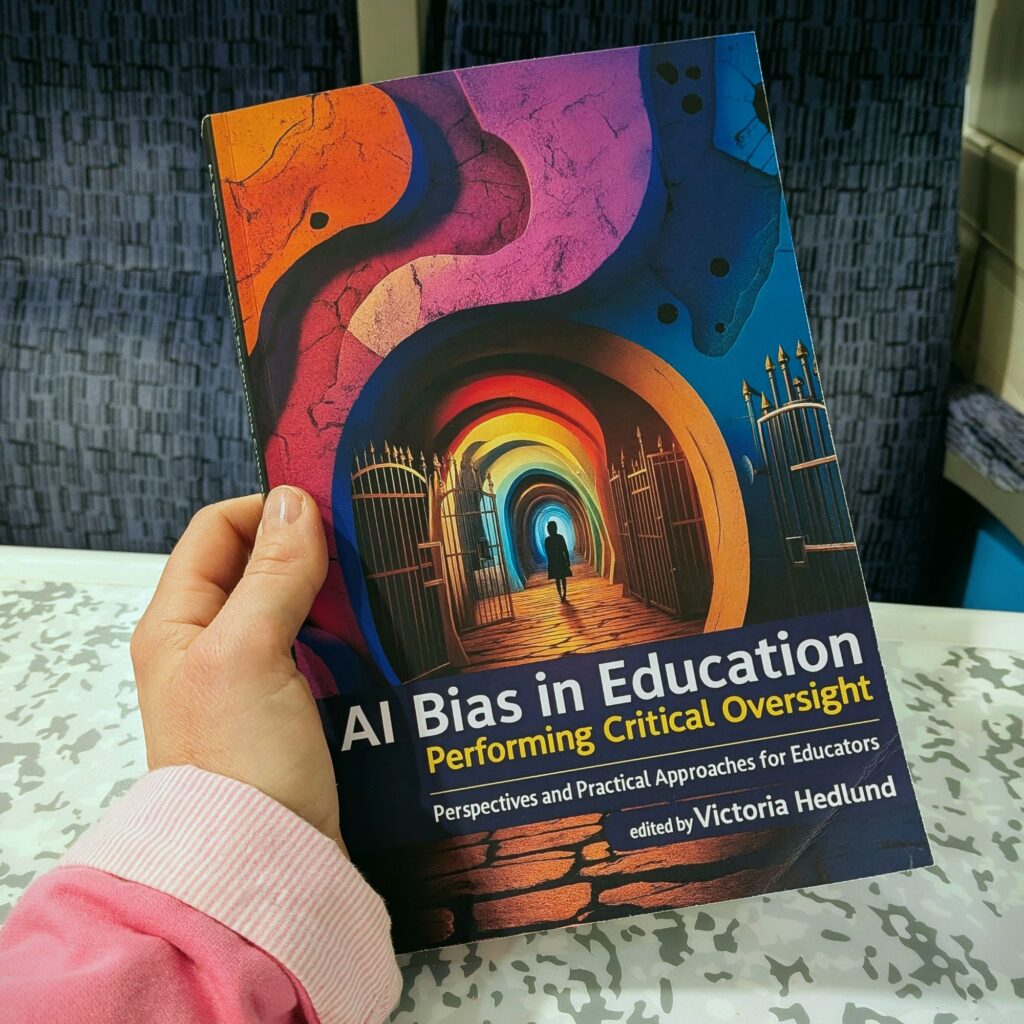
Before heading home, I was lucky enough to squeeze in a visit to a book launch presentation by Victoria Hedlund, known online as the AI Bias Girl. Victoria has been working hard to educate people about bias within AI, especially with reference to education to ensure these biases are not being brought into the classroom. I was lucky enough to receive a signed copy of the book and although I haven’t had chance to read it yet, from a quick skim through, I know it’s going to be an informative read. The book is called AI Bias in Education and currently available from Amazon, if you’re looking to ensure you’re ahead of the game when it comes to AI bias in your classroom I recommend grabbing a copy!
I’ll end my BETT overview here, but watch this space as I’m currently in the process of collating some of my recent AI research and training into a blog post too.
This is a great overview. Thanks.